
Employment Status
How Buró de Ingresos determines the employment_status field: possible values, signal priority, and recency rules.
employment_status summarizes the person's current relationship to work: are they employed by someone, working for themselves, retired, or without an active job right now?
We derive it automatically from the most reliable sources available — government records (IMSS / ISSSTE) and tax receipts (CFDIs: payroll and invoices) — so you get one clear answer without having to interpret the underlying data yourself.
Possible values
| Value | Meaning |
|---|---|
employed | The person currently has an active job with an employer. |
self_employed | The person is generating their own income (issuing their own ingreso invoices) without a current employer relationship. |
retired | Government records indicate the person is retired. |
unemployed | A recent, successful verification against government records (IMSS / ISSSTE) confirms the person has no active job. |
unknown | We don't have a recent, conclusive signal to make a determination. |
How we decide: signal priority
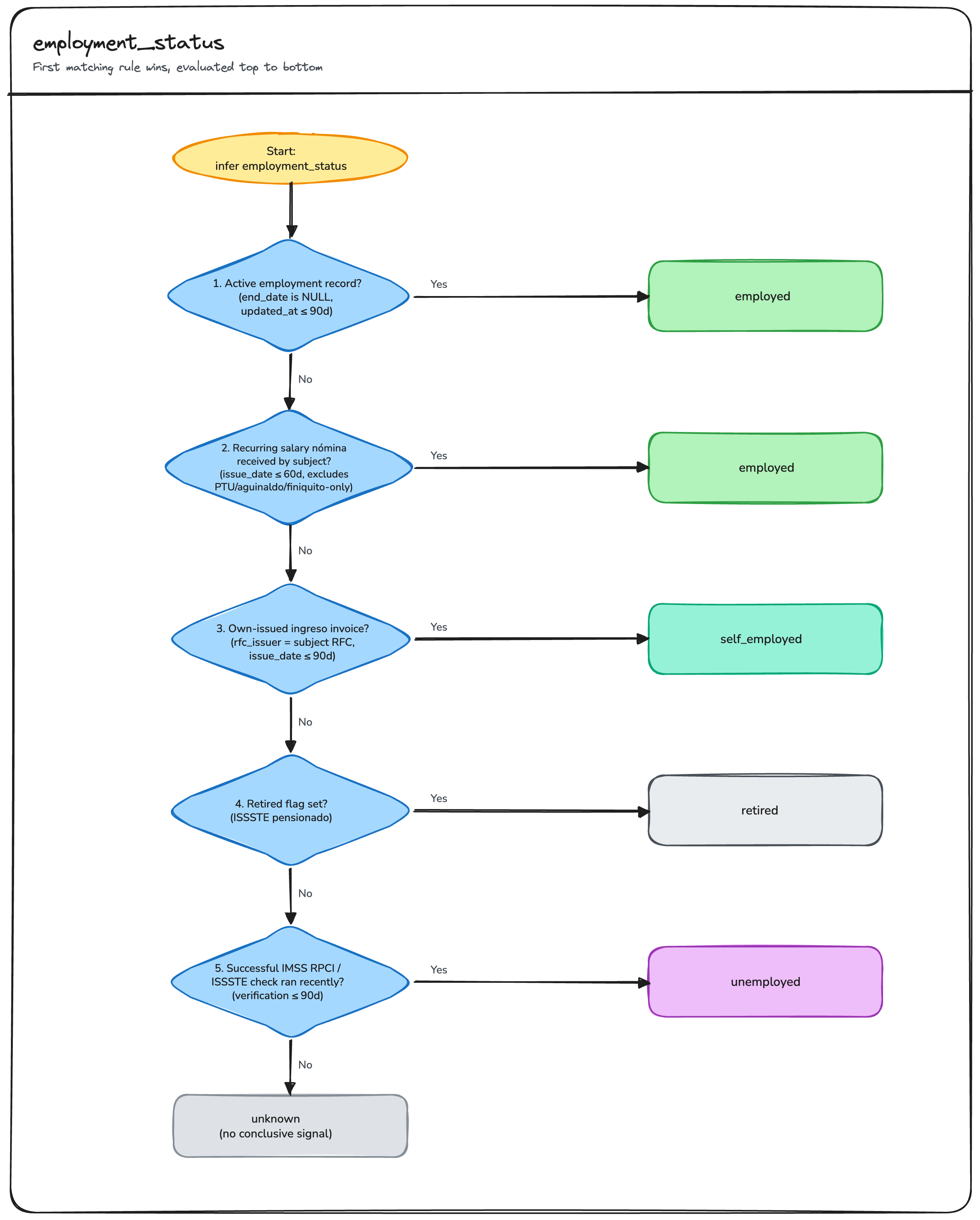
We check signals in order and return the first one that applies. A higher-priority signal always wins, even if a lower-priority one is also present.
| Priority | Signal | Source | How recent it must be | Result |
|---|---|---|---|---|
| 1 | Active job on record | IMSS / ISSSTE | Verified within last 90 days | employed |
| 2 | Recurring salary nómina received | CFDI nómina | Verified within 90 days, issued within 60 days | employed |
| 3 | Own-issued income invoices, no employer | CFDI ingreso | Verified within 90 days, issued within 90 days | self_employed |
| 4 | Retired flag | ISSSTE | No expiration. Once flagged, treated as permanent | retired |
| 5 | Confirmed no active job | IMSS / ISSSTE | Verification ran within 90 days | unemployed |
| 6 | None of the above apply | — | — | unknown |
What counts as "recent"
There are two separate things we check for freshness:
- How recently we verified the data — 90 days. For most signals, we only use it if we've verified it against the source within the last 90 days. This is about how recently we verified it, not about when the underlying event happened (a job's start date, an invoice's issue date, etc.).
- How recently the payroll receipt was issued — 60 days. On top of the check above, a received payroll receipt (nómina) only counts as evidence of a current job if it was issued within the last 60 days. Salaried pay is recurring — weekly, biweekly, or monthly — so an active job keeps producing fresh receipts well inside 60 days. A nómina issued more than 60 days ago is no longer treated as proof of an active job.
This keeps the status tied to the person's current situation: verifications that ran a long time ago won't influence today's answer. If the only information we have is outside these windows, the status is unknown rather than a stale employed or unemployed.
self_employed
self_employedA person who bills for their own work — a freelancer, a professional, or a small-business owner — issues their own income invoices (CFDIs of type ingreso) rather than receiving payroll from an employer. When we see income invoices issued under the person's own RFC within the last 90 days, and no active employer relationship, the status is self_employed. This distinguishes people who are actively earning on their own from those for whom we simply have no signal.
Why absence of data is not unemployed
unemployedNot finding an active job is not the same as confirming someone is unemployed. Government employment sources are not always available, so a missing record tells us nothing on its own.
We only return unemployed when a recent verification against government sources actually ran and confirmed there is no active job, specifically a successful IMSS RPCI or ISSSTE verification within the last 90 days. When there is no such confirmation and no other positive signal, the status is unknown, not unemployed.
Why a recent payroll receipt isn't always a job
Not every payroll receipt (nómina) means the person is currently employed. Some are one-off payments made to people who have already left a company, for example:
- PTU (reparto de utilidades) — annual profit-sharing, paid every May to anyone who worked part of the previous year, including former employees.
- Aguinaldo — the year-end bonus.
- Separation and severance payments (finiquito / indemnización) — paid precisely because someone is leaving.
A payroll receipt made up only of these one-off concepts is not evidence of an active job, so it does not result in employed. A receipt that includes ongoing salary (even alongside a one-off payment) still counts as employment.
Worked examples
| Scenario | Result | Why |
|---|---|---|
| Active IMSS job record, no end date, verified 40 days ago | employed | Priority 1 signal present |
| No active job record; nómina received 20 days ago with ongoing salary, verified 5 days ago | employed | Priority 2 — meets both conditions (verified within 90 days, issued within 60 days) |
| No active job record; nómina received 75 days ago, ongoing salary | Falls through to next signal | The nómina was issued too long ago — outside the 60-day window — even though we verified it within the 90-day window |
| No active job record; nómina issued 40 days ago but not verified with us in 100+ days | Falls through to next signal | We haven't verified this data recently enough, so it doesn't get considered at all, regardless of when it was issued |
| Nómina received 15 days ago, but it's only aguinaldo | Falls through to next signal | One-off concept only — not evidence of an active job |
| No employer relationship; person issued 3 ingreso CFDIs, most recent issued and verified 45 days ago | self_employed | Priority 3 — meets both conditions |
| No active job, no recent invoices; government record flags retired, verified 10 days ago | retired | Priority 4 |
| Government record flags retired, but hasn't been re-verified with ISSSTE in 100+ days | retired | The retired flag doesn't expire. It's treated as permanent once set |
| No active job, no recent invoices, not flagged retired; successful IMSS RPCI verification ran 30 days ago and shows no active job | unemployed | Priority 5 |
| No signals available at all, or all signals are stale | unknown | Nothing meets the recency requirements |
Related
- Estimated monthly income:
estimated_monthly_incomeuses the same recency rules — the 90-day cutoff for how recently we've verified the data, and the 60-day cutoff for how recently a payroll receipt was issued — and the same rule for one-off payments: PTU or aguinaldo are not treated as recurring salary when estimating income. - Employment data: the underlying IMSS / ISSSTE records are exposed in Employments.
Updated about 2 months ago